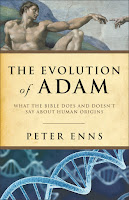
The second half of the book moves out into the New Testament, and here the star of the show, for good or ill, is Paul. Enns maintains (rightly!) that Paul's approach to the Eden story is - let's choose the adjectives carefully - innovative, creative and unique.
The role that Paul assigns to Adam in [Romans 5] is largely unique to Paul in the ancient world, and it moves well beyond what Genesis and the Old Testament have to say.Which is a polite way of saying that he doesn't have anything textually solid to hang his case on.
Again:
[A]fter Genesis 5, aside from 1 Chronicles 1:1 Adam makes no explicit appearance in the Old Testament. Further, the Adam of Paul's theology - as the explicit cause of human sinfulness and death - does not seem to be found in the Old Testament either.Which is a polite way of saying that Paul made it up. Why? Well, Paul is a complex thinker...
Paul's handling of his Scripture is notoriously creative and complex, not simple and straightforward.Which is a polite way of saying that Paul is either confusing, confused, or both. In one sense, however, Paul was not unique.
Ancient interpreters were not neutral observers of the text ... they read selectively, capitalized on ambiguities in the text, and brought it all to bear on some pressing concerns of their community.Which is, dare one say it, a polite way of saying that Paul, but not Paul alone, happily manhandled and shoe-horned the Old Testament to suit himself, and, glory be, this was perfectly okay.
Enns goes on to provide five illustrations of Paul's fast and loose approach to the Old Testament.
1. Isaiah 49:8 as used in 2 Corinthians 6:2
2. The misreading of "Abraham's seed" in Galatians 3:16 and 29
3. Habakkuk 2:4 as used in Galatians 3:11 ("Paul calls upon Habakkuk 2:4 to make his point, a passage that, in its Old Testament context... seems to make the opposite point.")
4. Isaiah 59:20 as used in Romans 11:26-27
5. Genesis 15:6 as used in Romans 4.
This hardly inspires us with confidence in Paul's abilities, a man who is often held to be the finest, most profound theologian of all time, bar none. Enns is blunt on Paul's singular but literal reading of the Adam character; after all this is the roadblock he wants to clear so likeminded Christians can embrace a scientific understanding of origins.
That's a worthy goal; may the force be with him. But:
Admitting the historical and scientific problems with Paul's Adam does not mean in the least that the gospel message is therefore undermined.Do you feel reassured?
Enns' wants us to see Paul as a child of his time, which is quite reasonable. He was however a shoddy interpreter of scripture, and anchored his gospel in multiple misunderstandings, but, hey, no worries, relax, it's all good. Paul may have been a third rate exegete, but...
Paul came to understand that the human plight was far deeper and more widespread than his own Jewish worldview thought.Oh, okay, so after all that Paul was indeed the deep, profound, insightful bloke we thought he was all along. Those darn Jews were just too dull to understand that. No wonder he had to play fix-it with the Old Testament. Sorry guys.
His reading of the Old Testament in general is creative, driven by both hermeneutical conventions of the time and - most importantly - by his experience of the risen Christ.There is a problem here, apart from the arrogant supercessionism.
Enns' Paul is, in effect, the real 'revelator', not Jesus. He pays no attention, for example, to the fact that Paul was regarded as a dubious character by non-Pauline Christians, as evidenced within the New Testament itself. Paul's interesting but flawed expositions of scripture are driven by his own visions ("his experience of the risen Christ") and arguably his towering ego. Why is this acceptable for Paul but not for Reverend Moon? Enns appears to stand in the camp of those who would claim that Paul is the real founder of Christianity, making the historical Jesus - along with the original Jesus movement - largely irrelevant, or peripheral at best.
And while we're flushing down Paul's opposition within the early church, we can apparently also feel free to marginalize Judaism and treat Paul's 'creative' use of the Hebrew Bible as the new gold standard.
Convinced? Not likely. Christianity was far too diverse right from the outset to make this a credible reconstruction.
Another problem: if Paul could legitimately play fast and loose with the scriptures, why not Benny Hinn? If anyone can explain that without indulging in circular reasoning, please let me know.
So, at the end of the day, I both admire The Evolution of Adam and am thoroughly discombobulated by it. Enns succeeeds brilliantly in identifying some key issues then, in my opinion, charges off up the wrong path entirely in his haste to put out possible brush fires.
The Evolution of Adam is hopefully just an opening shot in an ongoing conversation that evangelicals desperately need to get involved in.