Read the whole thing. Brilliant!1. The day was drawing to a close, and the twelve apostles came to Jesus and said, “Send the crowd away, so that they may go into the surrounding villages and countryside, to lodge and get provisions; for we are here in a deserted place.” 2 But Jesus said to them, “Why not give them something to eat?” They said, "We have no more than five loaves and two fish—unless we are to go and buy food for all these people." 3 For there were about five thousand men. And Jesus said to his disciples, “You know what? You’re right. Don’t waste your time and shekels. It would be positively immoral for you to spend any of your hard-earned money for these people. They knew full well that they were coming to a deserted place, and should have relied on themselves and brought more food. As far as I’m concerned, it’s every five thousand men for themselves.”

Sunday, 26 August 2012
The Not-so-Social Gospel


Saturday, 25 August 2012
The Jephthah Dilemma
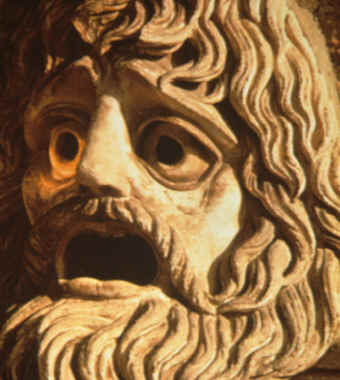 A nice posting appears on the Auckland Theology blog by Caroline Blyth, called "Before you say a word..." it's a shortlist of the stupider examples of 'verbal folly' (foot in mouth disease) recorded in the Good Book. There's the story of Jephthah, the genius who vowed to make a burnt offering of the first thing to meet him on his return home - only to be met by his daughter (who was he expecting, his mother-in-law?) Adam, the excuse-maker (it was the little woman who did it!), and Yahweh himself, enjoying a gentlemen's wager, and in doing so agreeing to the ruin of Job and the murder of his kids just so the Adversary could prove - or not prove - a point.
What do we do with stories like these, apart from grimace? Even allowing for the characteristics of the various genre - what edifying lessons are there to be learned? Preachers strain mightily in such tasks but, as it says in Ecclesiastes, usually bring forth little more than wind. Is the very best possible something like "look before you leap"?
In the case of Job it's generally agreed that the author has an intentionally subversive agenda, so perhaps we can cut some slack there. Even then, literary subtlety in a largely preliterate society would, you have to suspect, have been an underdeveloped skill, and dangerously easy to misinterpret. Do we risk imputing shades of meaning and depth where none were intended? Obviously. The finger pointing in Eden is more a cause for hilarity than reflection, and a wonderful resource for cartoonists. The Jephthah incident simply horrifies us, moreso because there's absolutely no indication in the text (Judges 11) that he did anything wrong by following through on the vow; the poor chap had no choice!
So what do those of us who love the Bible, warts and all, do with stories like these, apart from avoid shallow homilies? Yes, you can "preach against the grain", but why bother with something so counterintuitive when we could all be enjoying a nice selection from Tolstoy instead?
I doubt there's a short answer. Therein lies the problem.
Thursday, 23 August 2012
From Vic to Slick
 In 1980 or thereabouts I acquired my first computer, the simply amazing Commodore Vic-20. This was the age of the Atari, the Sinclair ZX81 and magazines that provided directions for Basic code that you could self-program by typing it out for yourself. Data was stored on a tape drive! Yet the sheer magic of plugging in to a new world of possibilities, as it existed then, is hard to describe. And that was before the Internet!
Time trashes all technology. From the Vic-20 to its gruntier big brother the Amiga, then a forced migration to the dark side... l've been a loyal PC user ever since. Desk tops, laptops. Not for one minute was I seriously seduced by the now forgotten Acorn or the alternate Apple platform. Mixed fruit and nuts.
 Now the game has changed. I've only just clued into the advantages of the tablet. Mobile phones have morphed into Android devices, and now, with a Jelly Bean powered Nexus 7 in hand - well, it's like 1980 all over again. Oh (with apologies to Dr. Seuss) the things you can do!
New Zealanders have been slower to make the move to tablets than most comparable societies, according to a NZ Herald report. Part of this may reflect the delay in getting new models into the country, as the article suggests, but overpricing may be a bigger factor. Another reason to be pleased that the Apple hegenomy has been breached.
Whether it's apparent at the moment, the desktop monitor, box and keyboard combo has effectively been reduced to retro furniture status, and the laptop's days are probably numbered. Even the Kindle Touch that seemed so cool a few months ago now has an Edsel feel to it.
Scary! What could possibly be next?
Wednesday, 22 August 2012
Son of David
 It's true. Jesus was the Son of David. The proof isn't just textual, or a matter of faith. The matter is beyond reasonable doubt.
But there's a small qualification. So was Judas.
And Peter, and John...
And Caiaphas, Mary Magdalene, the demonaics, old Uncle Tom Cobley and all.
"... everyone alive in the Holy Land at the time of Jesus would have been able to claim David for an ancestor."
Check out the fascinating article in the BBC News Magazine.
Monday, 20 August 2012
John Banks does it again
 He has a glowing resume in the world of Kiwi politics. Well, glowing may overstate it; his reputation has been well and truly tarnished by controversy over the years. John Banks was a minister in a previous National government and then, for a time, mayor of Auckland. These days he's the sole representative in New Zealand's parliament for the far right Act Party, and in a formal coalition with his former National Party buddies.
Life just keeps turning up roses for John. The man who was turfed out of parliament once before by voters, then lost the mayoralty, was thrown a sop for his single one-man-band vote, a juicy cabinet position. Described (jokingly?) as "barely literate" by a radio commentator, Mr Banks once again pulls in a handsome salary, this time not as a fringe radio talk-back host, but as associate Education Minister.
Nice.
Now Mr Banks has come out in favour of the dumbest form of creationism on offer. Being a politician, an expert on weasel words, he doesn't quite give his explicit endorsement to the YEC (Young Earth Creationism) fantasies... a point made on the Dunedin School blog (which has a transcript)... but it's pretty much implied.
Not for him the subtleties of ID (Intelligent Design). It's doubtful he'd even know what that was. Banks is reported in the NZ Herald as declaring "he believes the Genesis account of the start of life on Earth," telling Radio Rhema he has "no doubts the first chapters of Genesis are true." "God made the world in six days, with Adam and Eve his last act of creation."
Evidence? Oh come, why bother one's silly little head with evidence. 'True' for John presumably means as factual scientific accounts. No messing around with namby-pamby ideas of metaphorical truth here!
Which is fine, I suppose. It's a free country and you can believe any thing you please, and the facts - let alone the scientific method - can go hang.
But for heaven's sake: this man is associate Minister of Education!
And in secular New Zealand, not Uganda.
The political cartoonists should have a field day.
One particularly shallow press report states: "Bible scholars are divided over whether this is a literal description or an allegory to help people understand how the world came into being."
I guess it depends what you mean by "Bible scholars," but the overwhelming majority of those qualified in the field of biblical studies know full well what the Genesis stories are - and aren't.
The well-heeled voters of Epsom, one of Auckland's wealthiest and most highly educated electorates, must be having palpitations. They actually voted for this man because it seemed expedient, even if they had to hold their noses in the process.
My helpful suggestion is that they now settle back with a nice cup of Earl Grey and peruse the latest issue of New Scientist. With a bit of luck, come the next election, they'll think twice before making the same mistake again.
Saturday, 18 August 2012
Jesus and the Centurion's boy
 There's been a great deal of huff and puff over a story in the Huffington Post about the healing of the centurion's servant by Jesus.
 The story of the faithful centurion, told in Matthew 8:5-13 and Luke 7:1-10, is about a Roman centurion who comes to Jesus and begs that Jesus heal his pais, a word sometimes translated as "servant." Jesus agrees and says he will come to the centurion's home, but the centurion says that he does not deserve to have Jesus under his roof, and he has faith that if Jesus even utters a word of healing, the healing will be accomplished. Jesus praises the faith of the centurion, and the pais is healed. This tale illustrates the power and importance of faith, and how anyone can possess it. The centurion is not a Jew, yet he has faith in Jesus and is rewarded. But pais does not mean "servant." It means "lover."
In Thucydides, in Plutarch, in countless Greek sources, and according to leading Greek scholar Kenneth Dover, pais refers to the junior partner in a same-sex relationship. Now, this is not exactly a marriage of equals. An erastes-pais relationship generally consisted of a somewhat older man, usually a soldier between the ages of 18 and 30, and a younger adolescent, usually between the ages of 13 and 18. Sometimes that adolescent was a slave, as seems to be the case here.The article continues: "And what is Jesus's response? Does he spit in the centurion's face for daring to suggest that he heal the soldier's lover? Hardly. He recognizes the relationship and performs an act of grace."
After the predictable gasps of disbelief, it seems that even some more conservative academic bibliobloggers have agreed that this is indeed the most likely meaning. Who'd have thought this old Sunday School stand-by could be so controversial?
But then, the Bible comes to us from a "far country," both in terms of time and culture. Mores vary from society to society, and we are fools to project our own assumptions onto an ancient text in an unthinking way (which is, of course, exactly what most Christians delight in doing!) What should outrage us more; that the centurion's servant was his bed warmer, or that he was forced into that role through the institution of slavery?
 What is just as surprising is that this explanation of the passage has apparently come as a blast out of the blue to some working in the field of biblical studies. Feeling somewhat smug, I dusted off a copy of The Bible Tells Me So (Hill and Cheadle, Anchor Books, 1996) and found this quote which left me stunned a full decade ago.
Matthew 8:5, in which Jesus healed the centurion's "servant" (the original Greek reads "beloved boy"), suggests a homosexual relationship... (p.74)And that's in the Bible?
Yup. No wonder the standard translations and commentaries massage it into something safe and innocuous for the folk in the pews.
I'm not sure the story actually has much value in terms of current debates on homosexuality. The Hellenistic world is obviously (and thankfully!) not ours, slavery has disappeared from Western consciousness, and youngsters are protected from abuse and exploitation by the laws of our lands. In that sense our post-modern societies are better places than anything the Bible writers envisioned as remotely possible, short of the magical millennium.
The point here is that the Bible can still surprise us, once the devotional veneer is peeled away, even when the surprise comes in less than edifying form.
Friday, 17 August 2012
The sound of distant canons
 |
| Donna's 1st Ark Search... no sign here! |
McGrath makes some good points. There is no one canon of Christian scripture. The core is pretty solid, but there's a great deal of fuzziness around the edges.
"Canons of Scripture, which bring together diverse works from diverse authors in a wide range of time periods inevitably – as well as by intention – reflect the diversity within a tradition and not a monolithic unity. And so to treat a canonical text dogmatically is in essence to undermine and/or deny their canonical status, by pretending that what that one text says is what they all say, and thus flattening – indeed, riding roughshod with a steamroller over – the plurality of voices contained in that collection."Link that with former Buttwatch... (or was it Baywatch?) star Donna D'Errico's accident-prone hunt for Noah's Ark on Mt Ararat, and it's a posting well worth the energy of a click across to.
Subscribe to:
Posts (Atom)